
On 5 September 2026 media outlets in the Philippines ran a story about the country’s Department of Migrant Workers shutting down a labour hire agency which allegedly recruited Filipino workers for hospitality and services jobs in Bulgaria, Germany, and the United Kingdom without authorisation.

Nothing in the headlines indicated an obvious link to international student recruitment, and in any case the story only ran for a day and was easy to miss unless you are regularly scanning Filipino media sources.
The articles reference the DMW’s Anti-Illegal Recruitment and Trafficking in Persons Program. On the official Facebook page we find a News Alert posted on 4 September 2026, which provides more detail.

It identifies the sanctioned business as ANECON Tourism Consultancy Services Inc./ANECON Study Abroad, and makes the following key points:
- DMW issued a Closure Order against ANECON Tourism Consultancy Services Inc./ANECON Study Abroad for conducting overseas recruitment without a license or DMW authorization.
- The investigation was triggered by a Bureau of Immigration (BI) referral to the Inter-Agency Council Against Trafficking (IACAT), which found Filipinos traveling to Europe on Schengen Type C “seasonal worker” visas after being allegedly lured with study, internship, and employment offers.
- Surveillance found ANECON allegedly promoting employment-linked programs: Study Abroad with Guaranteed Work, Ausbildung, Au Pair, and Direct Work Program (UK and Germany).
- Programs were allegedly marketed via Facebook and other social media. Processing fees allegedly ranged from ₱200,000 to ₱400,000 depending on the program.
- ANECON officers and involved employees face illegal recruitment charges and will be added to the DMW List of Persons and Entities with Derogatory Record.
- DMW will seek cancellation of ANECON’s business permit and its SEC registration.
The allegations – and to be clear, they remain allegations – are serious and the DMW seems intent on pursuing the matter following its action to shutter the business. Clearly there is potential risk here for any institution linked to the study abroad part of the business.
Unknown unknowns
The first and most obvious question for an institution to ask is: “Is this agent one of our authorised agents?” If so, the institution’s agent management policy should guide the appropriate action. If the answer is “no” the institutional staff member or team responsible for education agent management may be inclined to feel momentarily relieved and then decide that no further action is required.
The challenge is that agent risk is often hidden and hard to detect. Sometimes issues or links that carry risks for institutions lie beneath the surface. Let’s apply the agent risk sonar to ANECON Study Abroad’s online presence to see what it reveals.
The agency runs three study abroad brands each with a separate microsite (all of which were still active as at 3 October 2026):
- Anecon Study Abroad Maple (CANZA)
- Anecon Study Abroad Gouda (Europe)
- Anecon Study Abroad Kimchee (Asia)
Those websites use the logos of the following educational institutions under the heading ‘School Partners’:
Table 1
| Abertay University | Kimpo University | Unitec Institute of Technology |
| Algonquin College | Kyoto University of Advanced Science | Universidad Católica de Murcia (UCAM) |
| Aroha College | MediaDesign Hochschule | Universitat de València |
| Avila University | Northern Lights College | University of Northern British Columbia |
| Business & Hotel Management School (BHMS) | OSA Private School | University of Windsor |
| Cambrian College | Sault College | Vin University |
| Canberra College of Management & Technology | Seoul School of Integrated Sciences & Technologies | Woosong University |
| Carlos V Education | Singapore Institute of Management | Yonsei University |
| Europa-Universität Flensburg | Study World Global College Malaysia | York St John University |
| KAI Global School | Tongmyong University |
It’s an eclectic mix, ranging from well-known research universities to institutions with a single campus and a narrow enrolment, located across more than a dozen countries on four continents.
The agency also operates three social media channels in line with the three regionally focused microsites listed above. For example:
- Anecon Study Abroad CANZA – Facebook
- Anecon Study Abroad Europe – Facebook
- Anecon Study Abroad Asia – Facebook
The accounts remained active as at 3 October 2026. Promotional posts use the logos of a large number of institutions.
Table 2
| Abertay University | Kyoto University of Advanced Science | Seneca Polytechnic |
| Adler University | Lambton College | Sheridan |
| Algonquin College | Langara College | St. Clair College |
| Business & Hotel Management School (BHMS) | Loyalist College | St. Francis Xavier University |
| Cambrian College | MDH University of Applied Sciences | St. Lawrence College |
| Canadore College | Medicine Hat College | Sung Kyun Kwan University |
| Capilano University | Mount Allison University | The University of Winnipeg |
| Centennial College | Niagara College Canada | Toronto Metropolitan University |
| CityUniversity in Canada | Niagara University | UNB (University of New Brunswick) |
| College of the Rockies | Northeastern University | Universidad Católica de Murcia (UCAM) |
| Confederation College | Northern College | Universidad de Granada |
| Durham College | Northern Lights College | Università degli Studi di Padova |
| European Sports Business School | Okanagan College | University Canada West |
| Fanshawe College | OntarioTech University | University of Alberta |
| Fleming College | OSA Private School | University of Guelph |
| George Brown College | Paris Business Academy | University of Niagara Falls Canada |
| Georgian College | Royal Roads University | University of Prince Edward Island |
| Humber Polytechnic | SAIT (Southern Alberta Institute of Technology) | University of Victoria |
| Keyano College | Saskatchewan Polytechnic | University of Windsor |
| Kwantlen Polytechnic University | Sault College | Woosong University |
It’s difficult to ascertain whether Anecon Study Abroad is an authorised agent of any of the institutions listed above because that information sits in the authorised agent lists maintained by institutions. Some institutions publish their agent lists – and doing so is best practice – but many don’t. Let’s take a look to see what shows up.
Based on the lists above we identified two institutions that list Anecon as an authorised agent – Aroha College (AU) and Canberra College of Management and Technology (AU).
In other cases Anecon was not listed, for example:
Table 3
| Institution | Is Anecon listed? |
|---|---|
| Abertay University | No |
| Toronto Metropolitan University | No |
| Unitec Institute of Technology | No |
| University of Windsor | No |
| The University of Winnipeg | No |
The sampling suggests it is likely that Anecon is not an authorised representative – or at least not directly authorised – of a significant number of institutions whose logos are used on its website and social media posts.
Aggregator links
What about indirect links through aggregators? Anecon’s corporate home page provides another line of inquiry here. Under the heading ‘Corporate Partnerships’ appears the logos of three large education agent aggregators – Adventus.io, GEEBEE Education, and MSM Unify.
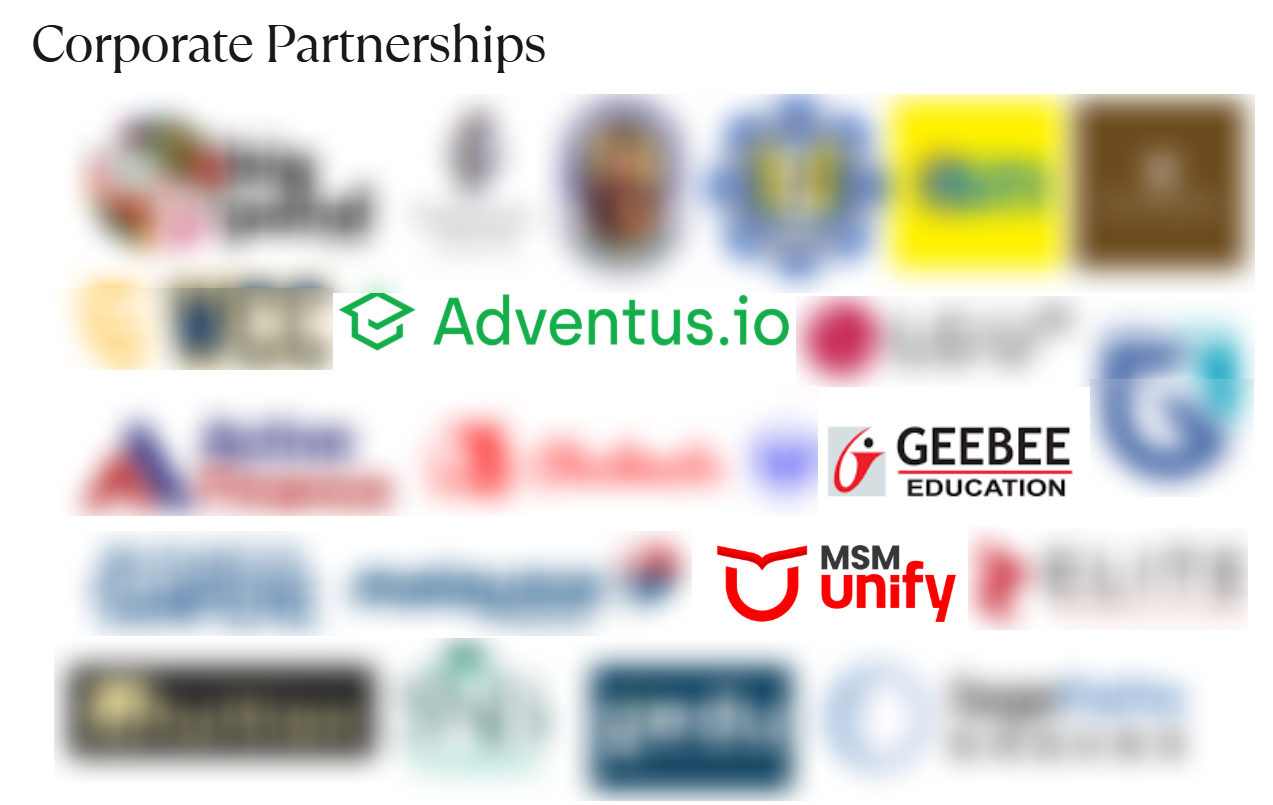
Our 2025 Annual Report: Agent Aggregators and their Sub-Agent Networks shows that all three were in the top 20 aggregators by size of sub-agent network. The use of the logos suggests that Anecon may be a sub-agent for each of the three aggregators, although we can’t know for sure because aggregators don’t publish lists of their sub-agents.
Let’s assume that Anecon is a sub-agent of the three aggregators mentioned above. It would go some way to explaining the claimed institution links in Table 3 above. For example:
- Abertay University lists Leap Gee Bee as an authorised agent in the Philippines.
- Toronto Metropolitan University lists Adventus.io as a global agent, and Leap Gee Bee in several country markets (but not the Philippines).
- Unitec lists Adventus as an authorised agent in Asia.
- University of Windsor lists Adventus and Leap GeeBee as authorised agents in Philippines
- The University of Winnipeg lists Leap GeeBee as an authorised agent for Asia and the Middle East.
Again, we’re making plenty of assumptions here, but the hypothetical analysis serves as an example of the potential for agent aggregator structures to obscure agent risk.
The takeaway
Agent risk isn’t always confined to the agents an institution has formally authorised. An agent’s use of an institution’s logo, or a marketing claim, can on their own create reputational exposure and potentially adverse student experience, with no formal relationship behind them at all.
In this case the exposure came from an agent using institution logos directly, and in at least some cases there’s no sign of a contractual relationship behind it. It’s possible the agent was operating as a sub-agent within an aggregator network, though that’s hard to confirm from the outside. Neither scenario gets picked up by an in-house team asking “is this one of ours?”. Where a sub-agent does sit behind an aggregator, the institution is usually relying entirely on that aggregator’s own vetting and monitoring with no independent line of sight into the sub-agents in the aggregator’s network, which often number in the thousands.
A complete approach to agent due diligence should reach beyond direct agent relationships to protect institutional reputation and, more importantly, students. In practice, that means periodic checks for unauthorised use of an institution’s name and branding, and a clearer understanding of what actually sits behind an aggregator’s network, rather than accepting assurances that sub-agents are ‘vetted’ or ‘trusted’ as a meaningful guarantee of integrity.
Sources: DMW Anti-Illegal Recruitment and Trafficking in Persons Program, Global Filipino Magazine, Daily Tribune
Education agent due diligence, done right.
AgentBee’s education agent due diligence solution supports educational institutions to implement best practice education agent due diligence processes.
Benefits:
- Protect students. Run thorough checks when you onboard an agent and keep monitoring after that, so problems surface early.
- Protect your brand. Find unauthorised agents using your name, logo or other IP, and act before students are misled.
- Make better decisions. Use evidence-based agent profiles when deciding who to appoint, renew or exit.
- Save your team time. Replace manual AI and web searches with an optimised agent risk solution for your institution.
Leading institutions rely on AgentBee…
Get new posts…
Follow AgentBee on Linkedin to get our latest posts on education agents as they drop – (click the icon below)
