On 15 October 2026, RNZ reported a dramatic jump in student visa refusals by Immigration New Zealand (INZ), with immigration advisers pointing to education agents in India and Bangladesh, and their sub-agents, as the source of a wave of fraudulent applications.
The numbers
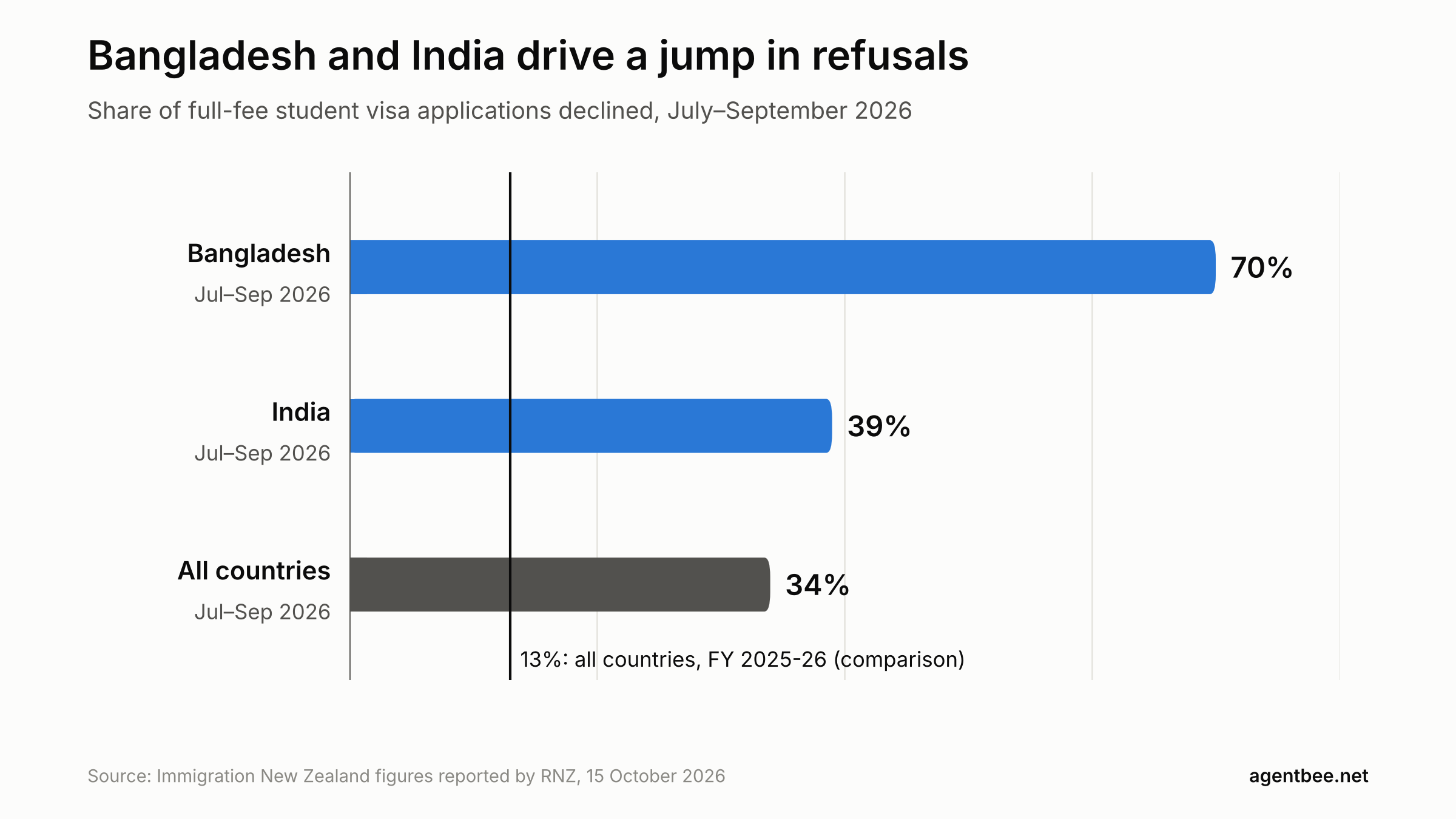
In July, August and September 2026, INZ declined 70% of student visa applications from Bangladesh and 39% from India, about double the usual rates. Across all source countries, INZ refused 6,273 full-fee student visa applications in that quarter, close to the 7,503 refusals recorded for the whole 2025-26 financial year. The overall refusal rate for full-fee study visas rose to 34%, up from 13% in 2025-26.
The refusals come against a backdrop of rapid growth. INZ said study visa applications were up 24% in the first nine months of 2026 compared with the same period in 2025. Bangladesh, which did not previously feature among New Zealand’s top source markets, is now third by volume of offshore student visa submissions. In the 2026 calendar year to date, offshore applications have come from India (22%, 9,103), China (21%, 8,751), Bangladesh (9%, 3,858) and Nepal (7%, 2,924). Advisers told RNZ that agents unfamiliar with New Zealand’s requirements had suddenly pivoted to the country after Canada and Australia tightened their rules.
What INZ says it is seeing
INZ said there has been no change to the requirements used to assess student visas and that all applications are assessed the same way regardless of nationality. It attributed the rise in declines to targeted assurance activity on some master’s-level applications.
In a statment to RNZ, INZ also pointed the finger at education agents:
INZ is seeing increasingly sophisticated fraud in student visa applications, including genuine documents being altered, reused or repurposed across multiple applications to make those applications appear legitimate. Fraud can involve groups of applications rather than just individual applicants and can be facilitated by agents. We regularly identify financial evidence being reused across multiple applications. These issues are not unique to Bangladesh or India. Recent declined applications from India, Bangladesh, Nepal, Nigeria and China have included concerns about fraud or false or misleading information.
Inside the sub-agent model
Arunima Dhingra of Aims Global told RNZ that INZ staff in India had described a spike in agents using fake documents to show students had sufficient funds, with hundreds of fraudulent documents from Bangladesh in particular coming through certain agents.
What immigration has been saying is with Bangladesh especially they’ve seen a spike in hundreds of fraudulent documents that have come through certain agents.
Documents were being recirculated and altered for different students, meaning the funds shown often did not exist, and financial providers were implicated. Dhingra considered the resulting crackdown heavy-handed, with genuine students caught as collateral damage and harm to New Zealand’s reputation as a study destination.
Himanshu Rai of Immigration Advisers New Zealand Limited expressed the view that much of the fraud could be attributed to sub-agents in aggregator or master agent business models. He said principal agents rely on sub-agents to prepare visa applications, and sub-agents sometimes reuse the same proof-of-funds documents because it is easier, even where the student genuinely has the required funds. Some go further, presenting their own company’s funds as the student’s and charging the student a fee for doing so.
The message for providers
INZ was explicit that providers are responsible for managing education agent risk:
Providers are expected to monitor the agents working on their behalf and take appropriate action where they do not meet expected standards. We also work directly with education providers when we identify concerns about agents connected to their students.
None of this is new for New Zealand. RNZ noted that refusal rates for India spiked in 2024 and around 2016, when sub-agents and fraudulent documents were last a major problem. This time, advisers also point to agents unfamiliar with New Zealand redirecting students after Canada and Australia tightened their rules.
Education agent due diligence, done right.
AgentBee’s education agent due diligence solution supports educational institutions to implement best practice education agent due diligence processes.
Benefits:
- Protect students. Run thorough checks when you onboard an agent and keep monitoring after that, so problems surface early.
- Protect your brand. Find unauthorised agents using your name, logo or other IP, and act before students are misled.
- Make better decisions. Use evidence-based agent profiles when deciding who to appoint, renew or exit.
- Save your team time. Replace manual AI and web searches with an optimised agent risk solution for your institution.
Leading institutions rely on AgentBee…
Get new posts…
Follow AgentBee on Linkedin to get our latest posts on education agents as they drop – (click the icon below)
