
On 11 June 2026, the war in Ukraine passed a grim milestone when it reached 1569 days – longer than World War I. The geopolitical implications of Russia’s invasion of Ukraine in 2022 and the ensuing conflict are profound and far-reaching.
Many universities and university groups in Western countries – including the main international student destination countries (i.e. US, UK, Canada and Australia) – publicly condemned Russia’s actions. Here are some examples:
Across the statements, the common thread is unequivocal condemnation of the invasion and expressions of solidarity and support for Ukrainian staff, students and institutions, but they diverge in the concrete action taken – ranging from purely symbolic condemnation and support offers (e.g. Group of Eight), to formal severance of institutional agreements (e.g. Universities UK suspending its MoU with the Russian Union of Rectors), to cutting of all ties with Russian universities (e.g. ANU).
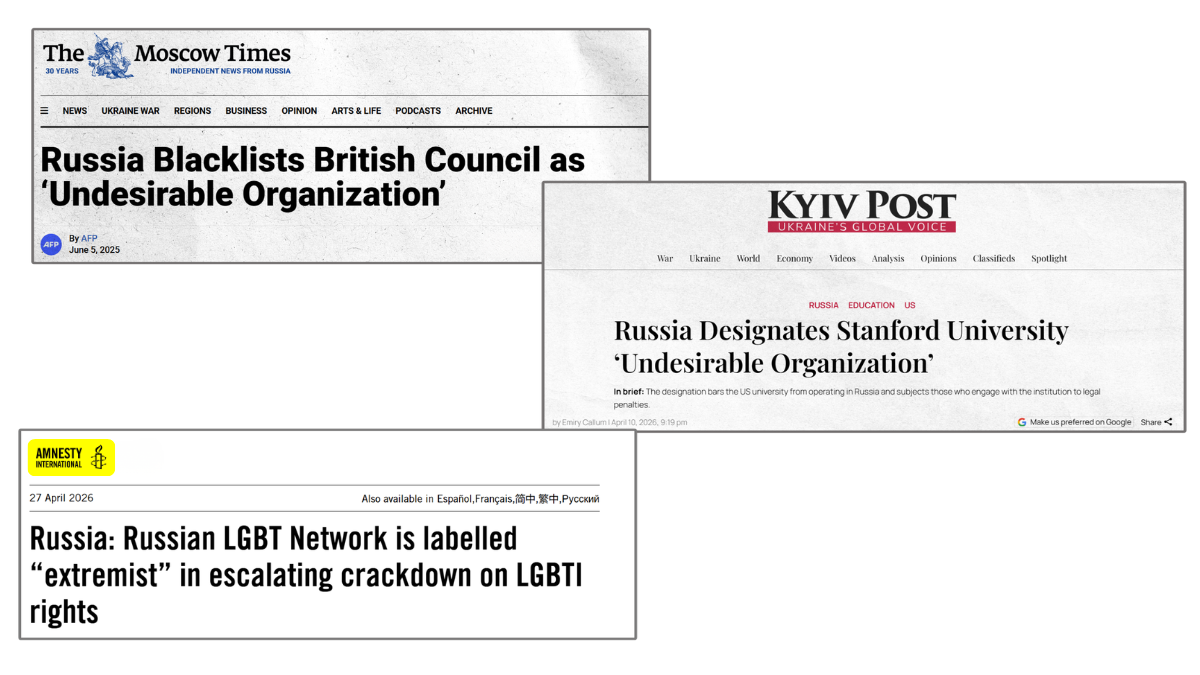
Russia has returned fire under its 2015 “undesirable organisations” law, which empowers the Prosecutor General’s Office or Justice Ministry to designate foreign entities as threats to Russia’s “constitutional order… defense capability… or security of the state.” A number of Western educational institutions have been listed. In June 2025, Russia listed the British Council as an undesirable organisation on the basis of alleged ties to UK intelligence (MI-6) and support for the “LGBT movement”. Also listed are several US universities, with Russia citing their support for Ukraine, content deemed critical of the Kremlin or its military, and association with LGBTQ+ advocacy, though in several recent cases, including Stanford and UC Berkeley, no official reason was given.
Recruiting for Russia
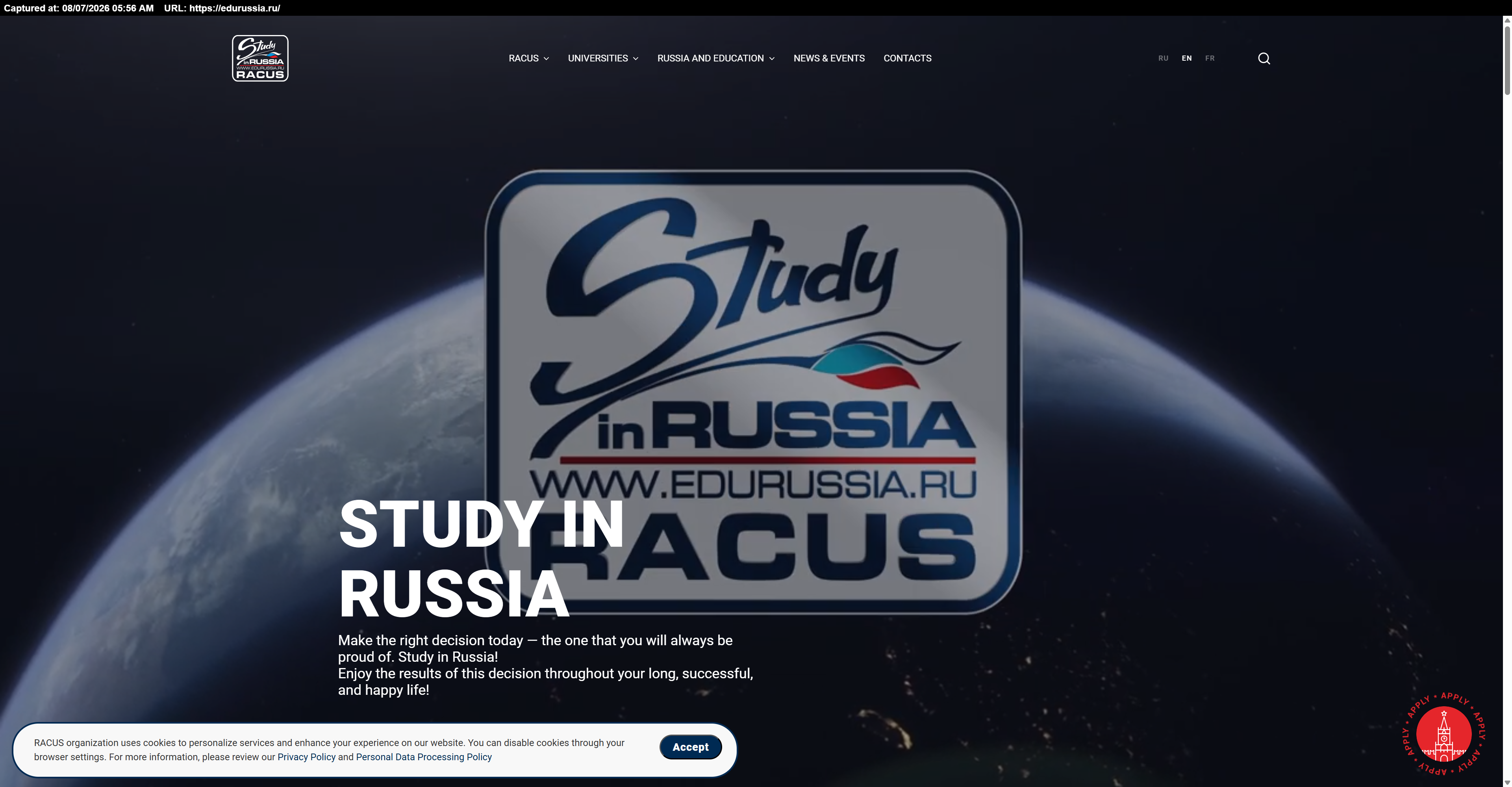
In the midst of this geopolitical storm many education agents, perhaps most visibly those in India and Pakistan, have continued to promote and place students at Russian universities. A recent corporate disclosure by publicly listed India-based agent Western Overseas Study Abroad Limited provides a useful example. On 3 July 2026, the agency wrote to the Bombay Stock Exchange to advise that it had signed an agreement authorising it to act as the official Indian recruitment representative for the RACUS Group of Russian state universities – sourcing, screening, and processing Indian student applications to those Russian institutions per Russian Ministry of Science and Higher Education requirements. The letter stated:
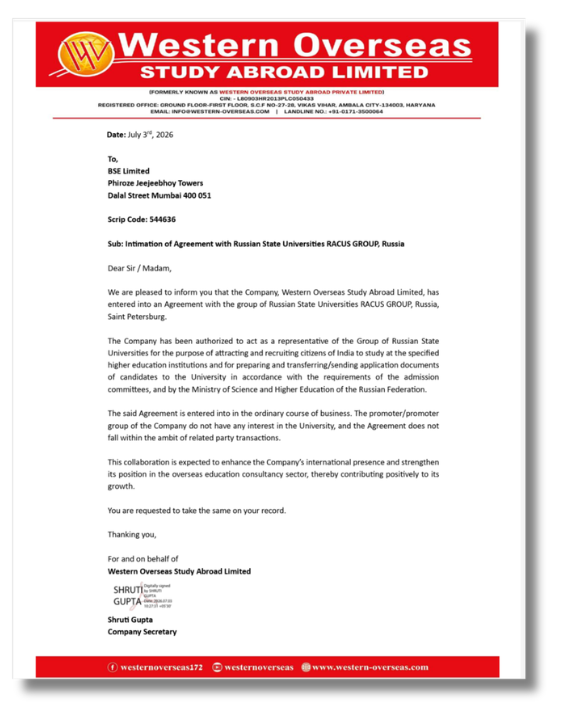
This collaboration is expected to enhance the Company’s international presence and strengthen its position in the overseas education consultancy sector, thereby contributing positively to its growth.
There is no suggestion in this post that Western Overseas has done anything wrong, or behaved unethically. Unlike the main destination country democracies – US, UK, Canada and Australia – the Indian Government has maintained strategic ambivalence on the war, balancing ties with both Russia and the West. India has consistently declined to formally condemn Russia’s invasion, framing its position instead around calls for an immediate cessation of hostilities, diplomatic dialogue, and respect for sovereignty, territorial integrity and the UN Charter. President Putin visited India in December 2025 where the two countries lauded their “special and privileged strategic partnership”. In this bilateral business-as-usual context, it is understandable that education agents in India would actively seek business opportunities in Russia.
Agents, sub-agents, ethics and reputation
Business relationships between education agents and Russian educational institutions raise issues of corporate ethics and reputation for institutions that have taken a position, publicly or privately, in opposition to Russia’s actions in Ukraine. For example, what are the implications if an institution’s authorised agent is also an authorised agent for Russian institutions? Is that OK as a matter of principle? Does or should an institution’s position in opposition to Russia’s invasion extend to the conduct of the institution’s agents? To put it another way, can or should an institution that strongly opposed Russia’s actions accept the fact that its agents are actively working to recruit international students for Russian universities, which ultimately benefits the Russian state?
Add the aggregator / sub-agent overlay to this and the questions for institutions remain basically the same, but the practice may well be less visible when it is happening across an army of sub-agents maintained by an aggregator that an institution has a contract with. Often this will play out in the social media feeds of sub-agents where Western and Russian universities are promoted side by side. What are the reputational implications if an agent is promoting Western and Russian universities alongside each other on the agent’s website or social media feeds?
Once again Western Overseas Study Abroad provides a useful case in point. Its Facebook page uses the names and logos of a significant number of educational institutions in the UK, Australia, the US and Canada. In early 2026 it ran recruitment fairs in India at which multiple universities were promoted, including use of their logos (see example posts). It is not clear whether Western Overseas Study Abroad has direct relationships in place with the promoted universities, or if they are acting as a sub-agent. In some posts the logos of agent aggregators, ApplyBoard and MSM Unify, are visible.
It does not appear that the agency has begun actively promoting Russian state universities on its website or socials, but it is on the public record stating that it is actively doing so. Putting this case aside, it is easy to find examples on agent websites and social media channels where Western and Russian universities are promoted side-by-side.
Compliance and values
Is agent due diligence about more than basic regulatory compliance? Is it also about whether the values an institution publicly espouses or holds internally are being honoured in practice through its student recruitment network? If so, how far should institutional values extend?
Agents are independent businesses. They operate across multiple markets, serve multiple clients, and make their own commercial decisions. There is no established norm that says an agent working with a Western university must align with that university’s geopolitical positions.
But institutions are not passive in this. They choose their agents, set the terms of those relationships, and decide what questions to ask, and what questions to leave unasked. For universities that have taken a position on Russia’s invasion, the question of who else their agents – and less visibly, sub-agents – are working for sits somewhere in that space. Whether it belongs on the due diligence checklist is a judgment call. But it is a call worth making deliberately, rather than by omission.
Sources:
Education agent due diligence, done right.
AgentBee’s education agent due diligence solution supports educational institutions to implement best practice education agent due diligence processes.
Benefits:
- Protect students. Run thorough checks when you onboard an agent and keep monitoring after that, so problems surface early.
- Protect your brand. Find unauthorised agents using your name, logo or other IP, and act before students are misled.
- Make better decisions. Use evidence-based agent profiles when deciding who to appoint, renew or exit.
- Save your team time. Replace manual AI and web searches with an optimised agent risk solution for your institution.
Leading institutions rely on AgentBee…
Get new posts…
Follow AgentBee on Linkedin to get our latest posts on education agents as they drop – (click the icon below)
