AgentBee monitors and reports on the education agent aggregator sector, drawing on the information available on aggregator websites and publicly reported information. This is our 2025 annual report.
Comings and goings…
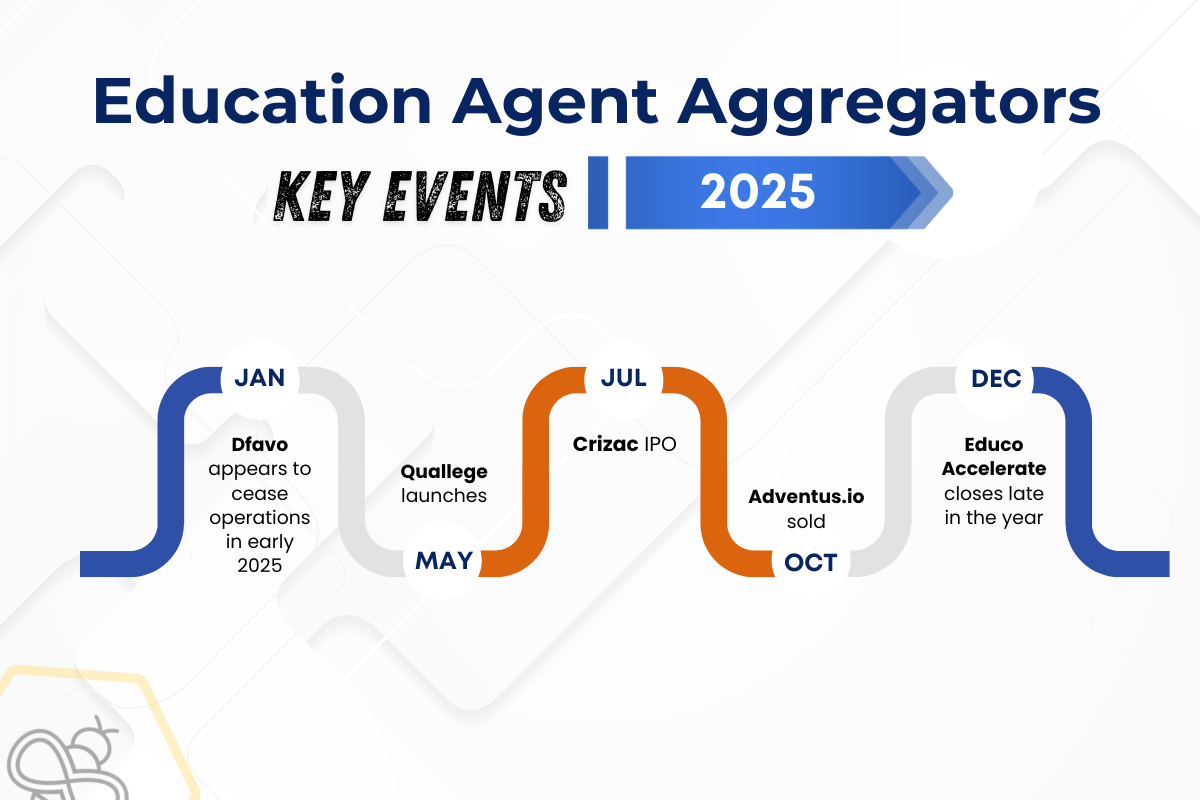
2025 was a year of significant change in the agent aggregator market:
❓ 1. Dfavo
- Some time in the first half of 2025 the website of Dfavo – an aggregator that as recently as January 2025 reported a network of 5,000 sub-agents – became inactive. It appears that the business may have ceased operations, at least as an agent aggregator.
🚀 2. Quallege launched as a new aggregator
- May saw the launch of Quallege, a new education agent aggregator specifically positioned to support U.S. colleges and universities in recruiting international students. At launch it boasted a network of over 6,000 recruitment partners globally, giving it immediate scale relative to other large aggregators. (See: Quallege: new US-focused agent aggregator launches).
💵3. Crizac completed a successful IPO
- In July, Crizac — an India-based education agent aggregator — conducted a successful IPO in India. Following the IPO, Crizac moved quickly to expand internationally, including acquiring UK-based Studies Planet to strengthen its presence in Latin America and beyond. (See: The Pareto Principle: Agent Aggregators and Sub-Agent Risk; Crizac acquires Studies Planet).
💸4. Adventus.io sold
- In October 2025, Adventus.io co-founder, Victor Rajeevan, announced the sale of the education agent aggregator to Dubai based education agency Global Edmissions. Rajeevan stepped away from the business, bringing to an end a 12 year journey. The terms of the sale were not disclosed, but Rajeevan described the deal as “a proud and successful exit after a smooth and rewarding transition”. (See: Adventus.io co-founder calls time as company sold).
❌ 5. EduCo Accelerate shut its doors
- In late 2025, EduCo Accelerate — a dedicated aggregator brand under the broader EduCo International Group — quietly ceased operations. (See: EduCo Accelerate stops).
Sub-agent networks
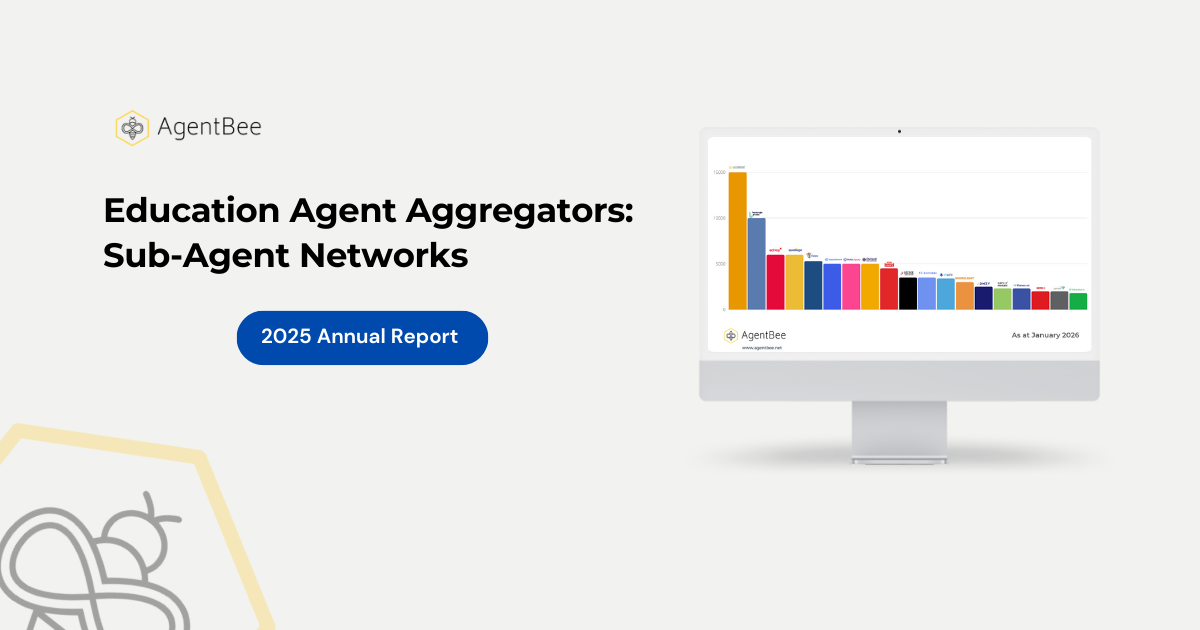
The chart below shows the historical growth of the sub-agent networks of the top 10 agent aggregators by reported number of sub-agents up to 1 January 2026.
Sub-Agent Networks – Jan 2026The Aggregator ‘League Table”
The table below shows the top 20 agent aggregators by size of sub-agent network (as at 1 January 2026) and the change over the last 12 months.
Aggregator Table – DEC 25 Sub-agent networks – DEC 2025What is the data telling us?…
- After several years in the top three or four in terms of sub-agent network size, ApplyBoard has come back to the peleton, and now sits with several other players at 5,000 sub agents.
- Adventus.io’s reported sub-agent network fell off a cliff, dropping from 8,000 in January 2025 to 1,800 by mid-year, a decrease of 77.5%.
Data gaps…
Some aggregators do not provide information about the size of their sub-agent network on their website – or at least not that we could see. Aggregators in this group include:
- applycourses
- iapply – a dedicated agent aggregator business operated by Canam.
- I-Unite
- Schooliply
- UniApplyNow
- Unizportal
- UpGrad GSP
- Yes Education
There’s no such thing as a free lunch
From an in-house institution compliance perspective, the scale at which modern education agent aggregators operate intensifies institutional risk.
Aggregators routinely state that their sub-agents are “trusted,” “vetted,” or “screened”. The critical issue, however, is what those assurances actually mean when set against the size of the networks involved.
Many aggregators now operate thousands of sub-agents, often spread across multiple jurisdictions, regulatory environments, and commercial contexts. In doing so, they are (or should be) taking on the same initial and ongoing due-diligence obligations that educational institutions themselves are required to meet when appointing and monitoring education agents directly. The use of an intermediary aggregator does not lower that standard.
For an aggregator, meeting that standard requires:
- uniform onboarding checks applied across the entire sub-agent network
- jurisdiction-specific regulatory, licensing, and corporate verification
- active, ongoing monitoring for misconduct, misleading marketing, data-handling failures, and unauthorised subcontracting, and
- regular re-validation, escalation, and enforcement processes that operate in practice, not just on paper
This is an industrial governance challenge. The uncomfortable reality is that scale itself is a risk multiplier. Even if the majority of sub-agents are compliant, a very small failure rate across thousands of agents translates into regular incidents that land squarely with the institution: data breaches, misleading marketing, misrepresentation of entry requirements, or regulatory non-compliance. Aggregators reduce friction and extend reach, but that efficiency is not free. It is purchased by accepting distance from day-to-day conduct and reliance on controls that sit outside the institution.
From a compliance standpoint, the key question is whether an aggregator’s processes are genuinely equivalent in substance, frequency, and evidentiary strength to what the university would be required to do itself. Generic assurances are not controls. In a market where sub-agent networks operate at scale, institutions that accept those assurances without understanding the underlying mechanics of the aggregator model are not outsourcing risk, they are absorbing it.
Quick compliance check: questions universities should ask aggregators
For institutions working with — or considering — an education agent aggregator, assurances alone are not enough. A practical way to test whether an aggregator’s governance framework is fit for purpose is to ask clear, operational questions that go beyond marketing language.
In particular, institutions should be asking:
- How are sub-agents on-boarded, and what ongoing due diligence is conducted?
Initial checks are only a baseline. Universities should understand the frequency, scope, and triggers for re-assessment across the entire sub-agent network. - How does the aggregator detect unauthorised sub-sub-agents?
Institutions should probe how the aggregator identifies onward subcontracting that sits outside approved arrangements, particularly in high-risk markets. - What triggers sub-agentnsuspension or removal, and how often does that actually happen?
Clear thresholds, documented enforcement actions, and real-world examples matter more than theoretical policies.
These questions are not adversarial. They are a necessary part of understanding whether an aggregator’s controls are operationally equivalent to the standards universities are expected to meet themselves.
✅Free Education Agent Risk Assessment
Regulatory expectations around education agent oversight are tightening. Across key study destinations, institutions are facing increasing scrutiny of agent relationships, stronger expectations around agent due diligence.
To support institutions navigating this shift, we offer a free agent risk assessment designed specifically for in-house compliance and international recruitment teams. The assessment provides an objective snapshot of agent risk exposure.
The free risk assessment will help you
- Understand the size and complexity of the agent and sub-agent networks your institution is connected to
- Identify hidden agent risk
- Prioritise where deeper due diligence or monitoring may be required
As expectations increase, institutions that proactively assess their agent risk position are better placed to demonstrate control, rather than having to explain it after something goes wrong. Click the link below and request your free risk assessment by email:
Trouble with the link? Email us at: buzz@agentbee.net
More reading on agent aggregators…
On a roll and want to go deeper on education agent aggregators? Check out some of our other posts:
- 2024 Annual Report: Agent Aggregators and their Sub-Agent Networks
- 2023 Annual Report: education aggregator sub-agent networks
- 5 questions to ask an education agent aggregator about their sub-agents
- Into temptation: the rise of education agent aggregators and sub-agent risk
- Crossing the edtech moat: aggregator disaggregation
- Education agents a focus in BC’s new Code of Practice
- Agent aggregator Crizac to IPO in India
- ApplyBoard cuts 3,500 ‘Recruitment Partners’
- Adventus.io co-founder calls time as company sold
- Working the room: sub-agents and their aggregator relationships
Get new posts…
Follow AgentBee on Linkedin to get our latest posts on education agents as they drop – (click the icon below)
